Commercial Utility Locating CO
Most GCs and site supers already know 811 stops at the meter. What usually decides whether a locate helps or slows the job down is who's showing up, how fast, and whether they understand a construction schedule. That's the part of commercial utility locating HPLS is built around.
How We Work With Contractors
You call or text, tell us the site and the sequence, and we schedule around it, not around a generic slot. Same-day is available when a locate becomes the thing holding up excavation, a pour, or the next trade in line. There's no dispatcher assigning whoever's free that morning: the person who quotes the job is the person who shows up, so there's one number to call with a question mid-project instead of a support line to route it through.
Most calls come from the general contractor or superintendent managing the schedule, not the property owner, and that's who this page is written for.
On-Site: What to Expect
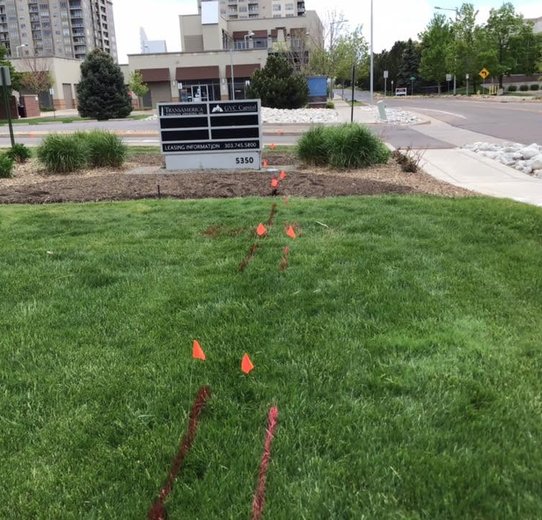
A commercial visit starts with a walk of the site against any plans or as-builts you can provide, then marking each private line directly on the ground, color-coded by utility type. Larger lots or sites with multiple buildings take longer than a residential lot, and we'll tell you upfront roughly how much time to expect rather than leaving you guessing.
You get photos and a rundown of what was found before we leave. That's usually enough for a field decision, but if it needs to go in a project file, get forwarded to an engineer, or back up a change order, ask for it in writing and it'll get sent over the same day rather than becoming a follow-up call.
What's Covered
On a commercial lot, the private side is usually more line footage than the public side, not less. Fire lines and sprinkler feeds get flagged first, since hitting one on an occupied or soon-to-open building means a system down, not just a repair. Lot lighting and signage circuits tend to run in directions nobody expects once the original electrical contractor is long gone. Communications and security lines, cameras, access control, data runs, are almost never documented anywhere, which makes them the easiest thing to miss without a locate. Private storm (where accessible), plus gas lines past the meter, round out what a standard commercial scope includes.
Pricing & Quotes
$250 an hour, one-hour minimum, covers the scope above on a standard commercial lot. Larger sites or multi-phase scopes get a walk and a written quote before anything's scheduled, so the number is set before the truck shows up, not reconciled after. After-hours and weekend visits are available at a higher call-out rate when the schedule genuinely can't wait for the next open slot.
Concrete & Slab Work
A locate covers open ground, not what's cast inside a slab. If the scope includes coring, cutting, or drilling through concrete, that's a separate check: our concrete scanning service finds rebar, conduit, or post-tension cable before anyone drills into it. This usually comes up once a plumbing or electrical penetration gets added to the scope, or when anchor bolts for equipment need to go somewhere specific, and it's worth flagging early since it can often be scheduled alongside the utility locate instead of as a second trip.
Multi-Site & Repeat Work
If you're running more than one project at a time, or you're the GC who calls every few months for a new site, the second job doesn't start from scratch. We're already familiar with how you run a schedule and what you need from us, and that direct line stays open project to project instead of resetting with a new tech each time.
Ready to get a site on the schedule? Text the address to (720) 318-1541, or submit the scope through the contact form if you'd rather send it in writing first. If a line's already been struck rather than needing to be found, go straight to fault finding instead.